



| Merz
to Emigre and Beyond: Avant-Garde Magazine Design of the Twentieth
Century Steven Heller 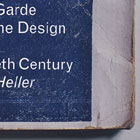 Merz
to Emigre and Beyond is an historical survey of avant-garde cultural,
art and political magazines and journals from the early twentieth
century to the present day. It examines the publications that were
at the forefront of graphic design throughout the century and which
challenged typographic convention, providing a platform for dissemination
of the ideas of the most radical art, design and political movements
of the last hundred years. Merz
to Emigre and Beyond is an historical survey of avant-garde cultural,
art and political magazines and journals from the early twentieth
century to the present day. It examines the publications that were
at the forefront of graphic design throughout the century and which
challenged typographic convention, providing a platform for dissemination
of the ideas of the most radical art, design and political movements
of the last hundred years. Steven Heller is Art Director of The New York Times Book Review and co-chair of the MFA/Design Program of the School of Visual Arts. He has written and co-authored over 80 books on graphic design and popular art. Heller is also a contributor to such design magazines a Print, ID and Baseline. In 1999 he received the AIGA Medal. Listen to WFMU Speakeasy show about Merz to Emigre and Beyond View book images The Paper Avant-Garde excerpted with permission of the author This book surveys the paper stage of twentieth-century avant-garde periodical publishing, specifically the design and typography of numerous magazines, newspapers, reviews and journals that in various ways have challenged the sanctity of art, politics, society and culture. Over the past decade, the Internet has had a major impact on the transmission of popular and unpopular ideas to large audiences all over the globe. Yet, before the digital era, paper was the most interactive of mediums and the avant-garde periodicals discussed in the following pages were agents of cultural upheaval. Without paper there could, arguably, be no avant-garde, but without an avant-garde, paper would be less volatile. None the less, electronic – and especially digital – media is currently usurping some of paper's role as a medium of provocation, and it will continue to do so as technology advances. Artist and propagandists in concert with technicians and programmers routinely test the boundaries of various new media, developing ingenious software to infiltrate the public mind while advancing their aims. The future of paperless communication is as yet untold, but paper's usability options are increasingly proscribed in today's multimedia environment. It is, consequently, difficult to think now of paper as the main delivery system for radical ideas, although it would be foolhardy to believe that a transformation to another medium will be complete and absolute in the very near future because the twentieth-century avant-garde relied so heavily on paper. However, periodicals will doubtless change with the new media, and the avant-garde by definition will lead the way. So, as the next epoch takes shape, this book takes stock of the paper avant-garde to examine what is truly radical about the journals produced by progressive individuals, groups and movements and why they became wellsprings of unprecedented art and design. “change is indubitable, whereas progress is a matter of controversy” The term avant-garde means the advance guard of unconventional ideas, especially in the arts, though not divorced from politics or society. The vanguard produces work that challenges the status quo despite the occasional threat of severe penalty. So an avant-garde is the instrument of radical change for better or worse, but always in opposition to the prevailing power structure. In whatever guise it appears, and however flawed it may be, the avant-garde is used (tacitly or otherwise) by societies as a means to trigger progress by disrupting complacency and promoting unacceptability. Because change can be frightening and, therefore, unwelcome, leaders of entrenched institutions often instinctively thwart the avant-garde whenever possible. Bertrand Russell wrote in Unpopular Essays, ‘change is indubitable, whereas progress is a matter of controversy.’ And controversy invariably follows avant-gardes around whenever they materialize. An avant-garde is rebellious in intent, and the job of rebels is to make trouble. Of course, trouble might be viewed as a dubious achievement, depending on one's allegiance and status within a particular system, but ultimately challenging the norms of any cultural establishment by attacking existing traditions and values encourages re-evaluation of the culture as a whole – a shift that is necessary to avoid social stagnation. Virtually every society has avant-gardes whose actions provoke, in this order, grave concern, concession and co-option – a fairly common evolutionary cycle except where societies have puritanical or dictatorial regimes that routinely expunge opposition and control behavior. Generally, avant-gardes have a small window of unacceptability, when the most radical characteristics are filtered out leaving only a veneer of insurrection in the form of popular style and taste, before their extremist ideas are adopted as ‘New Wave’. This is what happened with the Nineties music/culture magazine Ray Gun which spawned followers like Huh, Speak and Lava, each astutely borrowing the unconventional typographic codes and ultimately mining the radical ‘style’ of the originator to establish their own markets. “Periodicals that aggressively (and perhaps even dangerously) ignite rebellion with a view to challenging cultural complacency may be considered avant-garde, but not all manifestations of the avant-garde are violent” The term avant-garde, like au courant, has a modish ring to it, but must not be affixed like a designer fashion label on every attempt to transcend propriety – as commercial marketing departments are wont to do in their quest for the ‘next big thing’. Many periodicals look radical because they adopt type and layout that connotes radicalism, but in reality this is merely a veil. Just because something looks dangerous does not mean that is it – it could be pandering to an audience that believes certain typographies and images afford a ‘cool’ status. A magazine that is raunchy, obscene or tasteless is not necessarily avant-garde either, unless the purpose is clearly defined. Dada, in the early part of the twentieth century, and the Underground sex press during the later part, eschewed conventional notions of taste and decorum as an integral part of their respective missions. Periodicals that aggressively (and perhaps even dangerously) ignite rebellion with a view to challenging cultural complacency may be considered avant-garde, but not all manifestations of the avant-garde are violent. Movements are formed around a core – an idea, ideal or ideology – and avant-garde publications serve as rallying points that reflect, through word and picture, the principles on which the respective movements are founded. Publications can be the headquarters or the expeditionary forces – the base or the outreach – of such movements. The American journal Resistance, for example, was a clearing house (or base) of anarchist ideology targeted exclusively at its adherents, while the Scandinavian Social Kunst was a compendium (or outreach) of radical political artists, aimed at a larger audience. It is also axiomatic that members of such inherently contentious avant-garde movements as Expressionism, Dadaism and De Stijl are often at odds with one another over esoteric issues and their internecine battles are revealed in the pages of their respective publications. For example, the Dutch painter Piet Mondrian (1872–1944), who worked with only primary colours – red, yellow, blue and black – broke with the De Stijl movement, which he founded with the artist and architect Theo van Doesburg in 1917, over a disagreement concerning the latter's introduction of the diagonal. Mondrian felt that Van Doesburg had betrayed the movement's fundamental purist principles regarding the static immutability achieved through the maintenance of stable verticals and horizontals. He argued that retaining the equilibrium of the grid was the only way to find truth in plastic art. This seemingly inconsequential argument was rife with philosophical implications on the essence of art. The artists conducted their feud within the pages of journals like De Stijl, where they aired their views and attached each other. “avant-garde publications have therefore done more than simply inform or entertain: they have influenced social or cultural action” Without avant-garde periodicals, such critiques or other manifestos might not have reached targeted audiences. These periodicals served two vital functions for their movements: to signal a cultural position, through content and design, and to attract new adherents to the fold. Unlike mass-market magazines and newspapers, avant-garde publications have therefore done more than simply inform or entertain: they have influenced social or cultural action, often through provocation. Magazines like the Russian Artists' Brigade of the Thirties, for instance, inspired Soviet artists to use their art to promote the ideal of the continuous revolution and the German Die International sparked political action in the name of Communist ideology. Some avant-gardes were, in hindsight, actually regressive yet promulgated what, in their own periods, appeared to be progressive ideas. In fact, radical movements are not always inherently good. Vanguards are suspect because they disrupt, and disruption is abhorred by keepers of the status quo. The Italian Fascists were called ‘vanguardista’, and promoted themselves as a cultural shock troop that assaulted antiquity, destroyed continuity and raped convention. Well and good, but their message was ultimately tyrannical, dogmatic and corrupt. The Italian Futurist movement, a cultural vanguard that was in sympathy with the Fascist Party, was truly avant-garde because its proponents reinvented poetry, art and graphic design. Yet, given its creed of cultural disruption, it actively supported oppressive Fascist policies which led to Italy's occupation by the Nazis in World War II. Today Futurist art is a revolutionary paradigm but its underlying ideology remains unsavory, as evidenced by the scores of periodicals issued under the Futurist banner. “the goal of an avant-garde at its moment of inception is to destroy all existing value systems” Many avant-gardes may resolutely represent their respective Zeitgeist but circumspection may shine a more negative light on their once viable philosophy and ideals after the era has passed into history. The Sixties hippie obsession with drugs and free love, as projected through the first psychedelic Underground paper The Oracle, has certainly come under fire because of the adverse psychotropic effects that were levied on a generation during the decade of peace and love. So, the goal of an avant-garde at its moment of inception is to destroy all existing value systems, and radical periodicals provide a touchstone. However, for cultural transformations to have lasting resonance they cannot be innocuous, no matter how damaging their influence may be in the long run, so it is important to distinguish between an avant-garde and a cultural fad. Consumer society has come to accept and cheerfully anticipate the ethic known as ‘forced obsolescence’ – the commercially motivated, periodic alteration of form and style of goods – as a means of revitalizing activity in the market-place, but this is not to be confused with avant-gardism. A true avant-garde will not overtly appeal to mass taste, and indeed encourages bad taste as a means to replace the sanctified with the unholy. An avant-garde has to produce such unpleasant alternatives to the statue quo that it will be unequivocally and avidly shunned by all but those few who adhere to it. An avant-garde must make noise. Avant-gardes can be likened to gangs of cultural thugs that force their way through the safeguards of the social infrastructure and use art and the media as a means of ramming home unorthodox ideas. Twentieth-century avant-garde periodicals were more or less the apparatus of disobedience designed to rally the faithful and to offend the compliant. And in this critical mass of radical thought and deed, design is the key. Although words are the building blocks of meaning, visual ideas can be expressed much more persuasively through the medium of graphic design (the marriage of typography, layout and image); it is a code that telegraphs intent. One might argue that radical ideas must appear vanguard to be vanguard. Harsh words on a tame page cannot have the same impact as a boisterous layout. The impression portrayed through design must be unsettling, if only as first, in order to provoke the reaction of reader. The design of most Dada publications produced during the early Twenties purposefully disrupted established professional norms by redirecting traditional sight and reading patters in order to send a signal that nothing of the past, not even the most neutral or transparent of typefaces, would remain unscathed. Revolution is meaningless unless it discomfits the ancien rĖgime. “Some were Trojan horses, designed in benign skins so as to sneak into respectable quarters” Avant-gardes attack the status quo through many art forms – painting, sculpture, theatre, music, film, video, dance, poetry and even clothing. So, while periodicals are by no means their only medium, owing to the immediacy (and ephemeral nature) of magazines and newspapers they have served both as a channel for ideas and Î in the spirit of Marshall McLuhan's mantra of medium as message – as the ideas themselves. The periodicals surveyed here have fulfilled these two roles with varying degrees of success, and at different levels of intensity. Some have fought existing power structures at the expense of their own freedoms (Mother Earth, the American magazine edited by Emma Goldman, was banned after the Americans entered World War I in 1917 and Goldman, a Russian national, was later deported back to the Soviet Union); others were able to push limits because they were not suppressed by (or did not threaten) the establishment (the Underground paper New York Ace, for example, engaged in left-wing rabble-rousing but managed to stay inches clear of censorship). Some were Trojan horses, designed in benign skins so as to sneak into respectable quarters (the American magazine Evergreen Review was professionally designed, partly to veil its charged content). Others looked as flagrantly extremist as their philosophies demanded (the Mexican magazine El Corno Emplumado [The Plumed Horn] exemplified the radical spectrum of erotic, Surrealist art). Examining many of these reviews today in the light of seemingly more radical developments in new media, one might wonder what all the fuss was about. The degree of shock needed to cause outrage these days, and to disrupt the equilibrium of the body politic, has long since risen to the most absurd levels of abomination that far exceed the capacity of mere periodicals printed on paper. With all that is transmitted electronically, what is printed on paper must do a lot to make the world take notice. But this is exactly why these artifacts are so fascinating. Once upon a time print on paper could unlock passions, ignite emotions, and change the world, if only for brief moments. |

|
[ top ] ©2002 AIGA NY. All rights reserved. Want to reproduce something? Ask. |