|
by Jessica Helfand
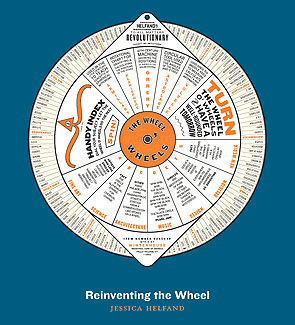
This essay originally appeared in Reinventing The Wheel, published by Princeton Architectural Press, and is reproduced here with the kind permission of the author. Purchase the book directly from Princeton.
The idea of deploying the circular form as a device capable of precise measurement,
speedy calculation or accurate wayfinding introduces a surprisingly rich platform
upon which to argue the merits of kinetic thinking. Wheels are, of course,
implicitly dynamic. They represent precision on the one hand, yet suggest an
infinite kind of permutation on the other. They embody at once a balanced symmetry
yet simultaneously embrace endless possibilities for imbalance, irregularity,
and a kind of irreverent compositional frenzy—what the writer Joseph
Conrad once called “a mad art attempting the inconceivable.” Nevertheless,
the visual language of wheels endures as a universal symbolic code, representing
not only the heavenly bodies but possessing, even in these modern times, a
remarkable capacity to communicate a kind of instant civilization. Efforts
to “map” the internet rely heavily on this paradigm, borrowing
from the same formal lexicon that once captivated Plato and Aristotle. Such
reasoning—part ideology, part cartography—endows the wheel with
properties at once mobile and mercurial: representing metaphorical nodes of
content, it can suggest earth or sky, planets or comets, terrestrial bodies
or virtual ones.
“We expect our information filtered through the reliably rectangular coordinates of Cartesian logic”
And yet ironically, the very notion of the circle-meets-technology instantly conjures up not progress, but its very absence. We imagine instead the most archaic of technologies: oversized television sets and cumbersome radio consoles, telephone switchboards and analogue synthesizers—all of them “navigated” by bothersome dials and bulbous knobs. (Hardly the stuff of modern convenience, let alone a paradigm for progressive interaction design.) Conversely, in contemporary culture, we expect our information filtered through the reliably rectangular coordinates of Cartesian logic, digesting our data in bytes and bits, pixels and voxels, squared-up monitors and drill-down menus: it’s a tyranny of rigorous alignments that mirrors the rational substrate of modern civilization where text squares up, buildings stand up and the world, by and large, follows an orderly, axial progression of straight lines and right angles. (Arnheim is indeed correct in his observation that the circle bypasses this logic entirely.)
Of course, the notion of mediating the tension between rational (square) and
rotational (circle) is hardly new: indeed, one of the earliest problems in
Greek mathematics was something called “squaring the circle.” The
problem was, given a circle, to construct geometrically a square equal in area
to the given circle. (To date, the idiomatic expression ‘circle-squarer’ is
used to describe someone who attempts the impossible.) But does “squaring” the
circle also reflect our subconscious effort to impose upon it a kind of forced
logic, a grid of tangible traces and proper parallelograms?
Such tensions remain at the core of modern visual expression, particularly
in an age in which new technologies invite us to reconsider traditional spatial
and representational metaphors. Does geometry represent order, or chaos? Does
circularity reflect an organic cycle or a synthetic one? Is rotation itself
a conduit for mobilization or an emblem for meditation? If flat, concentrically
aligned cardboard discs once served to facilitate simple information retrieval,
then what can be said of circles that combine and blend, repeat and intersect,
rotate, dilate, spin and swirl—revealing more dynamic information, and
arguably, suggesting more depth of experience beneath their simple geometric
façades?
“Interaction itself has become increasingly complex”
Contemporary experiments in circular artistry pose precisely such questions—at
once simple and provocative, they challenge our perceptions of reality, dimensionality
and optics. (If wheels can move, then so can urban courtyards, corporate trademarks
and computer interfaces.) Increasingly detached from the very computer that
previously “framed” our experiences through the confines of its
rectangular monitor, interaction itself has become increasingly complex. Though
describing the work of David Rabinowich, historian Whitney Davis might have
been discussing precisely the kind of “out of the box”-ness that
typifies such alternative thinking when he wrote: “From one point of
view, the question insists: who ordained the frame itself? But from another
point of view, the frame melts away.”
Today, after its own somewhat brief incunabula, advances in technology now
enable multiple opportunities for visualizing dynamically generated information—information
that is no longer bound to the screen or to the confines of the x-y axis. Such
possibilities challenge visual thinkers to rethink presentation and representation,
the demarcation of boundaries, the delineation of movement in space. On the
screen, a good deal of this movement is rotational (consider the rollover),
elliptical (forward and back buttons) and orbital (imagine a typical trail
through a meandering landscape of “links” which, if it were to
be mapped in a connect-the-dots sort of way, would much sooner resemble a “coruscating
whirl of circles” than a rational compendium of right-angled paths.)
In a model that recalls Ivan Illychês notion of “convivial media,” what
soon becomes clear is that the participation of the human mind, hand or even
body (any of which may become, from a psychological perspective, the core “link” of
any perceived interactive experience) lends itself much more naturally to curved
and circular forms than to rectilinear ones.
For designers in particular, the opportunity to think interactively in such a broad and indeed, holistic sense introduces critical questions about form and content, perception and usability, the multiple ways we seek and retrieve information. In any of a variety of media and dimensions, the rotational circle, or wheel introduces a reliable visual system—a vocabulary rooted in geometry and order, harmony and balance—that unlocks an important evolutionary step in the representation of abstract ideas.
Indeed, if the astronomical volvelles of the incunabula once sought to compress three dimensions of data onto two, it might be said that modern wheels (and by extension, modern interpretations of rotational forms) do precisely the opposite, employing kinetic conceits to infer added depth and increased dimensionality, challenging the surface, and with it, our notions of where the surface actually is—if indeed it exists at all.
|
|
|
|