



|
Page One A Conversation with Philip Gefter, Picture Editor of The New York Times’ Front Page by Veronique Vienne 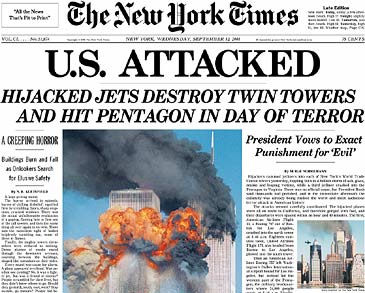 This interview originally appeared in Aperture No. 162 Winter 2001 For more information visit www.aperture.org Everyday of the week, at 4:30 p.m. precisely, twenty or so of the best-informed journalists in the world assemble in a conference room on the fourth floor of 229 West 43rd Street in Manhattan. They meet to determine what the most important news of the day will be in tomorrow’s New York Times. The Page One meeting, as this august gathering is called, is a thirty-minute ritual during which editors of the “World’s Most Authoritative Newspaper” (nearly all of them men, incidentally) choose not only the top stories, but also the two or three photographs that will appear as emblems of what is happening in the world on their front page. One of the participants at this meeting, Philip Gefter, was appointed Page One picture editor in 1999. Like the other editors at the Page One meeting, Gefter is fully aware that the careful balance of words and images on this 22-by-13.6 inch sheet of paper will be scrutinized by readers, among them the most prominent leaders and thinkers of our time; he brings to this gathering the sum total of his professional expertise as well as his personal convictions about art, objectivity, and truth — though not necessarily in that order. Gefter makes a point of distinguishing between pictures that are simply “illustrative” of a new event, and pictures that are “edifying” — that is, pictures that are not merely additions, but illuminating in themselves, integral to the report. “A photograph on the page can edify when it opens a window on a story rather than simply being a proof of the story,” he explains. It was after seven years of comprehensive orientation in the New York Times newsroom that Gefter faced the austere Page One challenge. He had received his BFA in painting and photography at the San Francisco Art Institute and at New York University’s Tisch School of the Arts. When he first joined the Times in 1992, he worried that he might be a little too flamboyant for them. No stranger to the gallery scene, he had been curator for a number of photography exhibitions, written critical essays and penned quite a few published and unpublished short stories. In fact, just prior to accepting his first assignment at the Times as a picture editor for the newly redesigned Metro Section, he had been a guest on “The Phil Donahue Show”, talking about a controversial book he was writing on “the difference between sleeping with men and women.” An important part of his job at the Times, Gefter soon found, was to be able to spell out concisely the who, what, when, where, and why of each picture. Though he was an accomplished wordsmith, who had secured his credentials as a picture editor at a number of national publications (including Forbes, Geo, Fortune and the San Francisco Examiner’s Sunday magazine), Gefter had to learn from scratch the science of caption writing for the Times. One of the early captions he composed at the Metro desk (where he stayed for eighteen months before moving on to other sections—the Week in Review, The Business section, and the foreign desk among them) was to accompany a Thanksgiving photograph of a turkey milling around a turkey farm. “The melancholy days before Thanksgiving,” he wrote ironically. Soon after, a post-mortem memo was circulated; next to the picture of the gallinaceous bird was a stern admonition: “We should not ascribe anthropomorphic feelings to farm animals.” That was almost a decade ago. Today, Philip Gefter is a seasoned journalist who doesn’t take lightly the task of selecting and captioning news pictures. Last August, during the heat of the presidential campaign, he explained how privileged he feels to be part of the Page One process, and how five days a week he methodically puts together words and images for what he says is “probably one of the most important meetings in American that day.” Véronique Vienne: How would you describe your role at the New York Times? Philip Gefter: Sometimes I feel that I am the Curator of the Pictures of the Day. Over the course of eight to ten hours, I monitor all the photographs and all the available information regarding the events of the day—in real time, as they happen. VV: How many photographs do you look at? PG: Hundreds, daily. Basically, I have access to all the news pictures from around the world—the pictures and their captions, right there, on my desktop. All the wire pictures, from Reuters, Agence France-Press, and Associated Press. That’s one level of images. Then there are the photographers that are assigned by the Times—by all the news desks, whether Metro, national, or foreign. Their photographs are entered into our computer network, and they appear on my screen. If I check all these pictures first thing when I arrive, and before I go into the Page One briefing at noon, during which we preview the top news of the moment, I can stay on top of new pictures as they come up through the day. VV: How many photographers provide pictures to the New York Times? PG: We have more than twenty-five local staff photographers. They are working all the time. They are being fed assignments by reporters, by news editors, and by any of the thirty or so picture editors from various desks. We give them up to fifty or sixty assignments a day, including what we call “day pictures,” a newspaper tradition: these photographs are supposed to capture the “mood of the day”—a slice of life—and sometimes there is an appetite for them on the front page. Often, too, there are front-page feature stories that we assign. I will work with various picture editors on these projects. If I feel that the images for the story are inadequate for the front page, I can ask for a re-shoot, or suggest a second look at the take. Occasionally, like in the case of the series “How Race is Lived in America,” the picture selection for the front page is handled by the editors who oversee the project. Last but not least, there are all the so-called generic pictures I have archived with the idea that they might be useful some day. Like the Agence France-Press photograph that ran recently, showing people watching an eye operation live, on multiple screens in a mall. I had found it about a year ago. It turned out to be perfect on the front-page story on the business of eye surgery from the Science section. VV: How many stories do you read before the 4:30 p.m. meeting? PG: By the time I get to the Page One meeting at the end of the afternoon, I have read all the stories being offered for the front page from the respective desks—a dozen or more—and I have assembled the pictures I think work best for them. I then know what’s important in terms of the news; I know what’s relevant. But that’s not enough. I have to be able to talk about the pictures, not in terms of a visual language per se, but in terms of the information they provide. If I do so, the poignant editorial details will always increase the chances of pictures making it to the front page. VV: How do you talk a picture to Page One? PG: I operate on the principle that words are cerebral and pictures are visceral. For many word-people, it seems as if a photograph gets filtered through a mental process before it is registered as an image. That’s why it’s important for me to provide thorough information about the pictures first. Letting the editors know at once in what ways a particular picture is relevant to the story or the news—that’s a critical part of my job. Finding the right words to talk about images is something I have spent a lot of time working on. It takes focus and discipline, yet at the same time it’s one of the most thrilling things I do. I think there was an attitude at the Times—at many publications—that the picture desk was more a service desk than a journalistic equal. I have seen that attitude change. And, while it has been a long process, I want to give credit to my boss Margaret O’Connor, the Director of Photography, and to her deputy Mike Smith. Their efforts to engage a dialogue about pictures in the newsroom are paying off. I am aware that every time I go into the Page One meeting, I am representing everyone at the picture desk. I try my best to introduce the pictures with as much accuracy of detail, efficiency, and relevance as possible. VV: How do you accomplish that? Do you write all the information down? PG: All afternoon I think about how I can best present the ten or twelve images I have selected to show at the 4:30 p.m. meeting. I scribble notes as I go along, rewriting them and refining my thinking about each picture. Thirty minutes before the meeting, I sit down and script what I am going to say, word for word. By the time everyone gathers in the Page One conference room—well, it’s show time. VV: Who attends the Page One meeting? PG: There are about twenty people in the room—each one the head of a department or a section—the National Editor, the Metro Editor, the Foreign Editor, as well as the Science, Culture, Business Editors, and so on. Add to these the newspaper’s Executive Editor, Managing Editor, Deputy Managing Editors, and Assistant Managing Editors—what we call the masthead. VV: And everyone at this meeting must be extremely well prepared? PG: Absolutely. Each editor presents the most important stories of the day from their department. When it’s my turn, I show my gallery of images on an electronically projected desktop. A veritable slide show. After this meeting adjourns, only a half-dozen people remain, including me. And that’s when the front page is drawn, by hand, on a green layout pad—when the stories are places on the page according to their importance, and when the final two or three pictures are selected. VV: Are the more complex issues hashed out? Do questions come up about the objectivity of the paper? PG: Yes, of course there are discussions. But, as a picture editor, I walk a delicate line. I choose carefully the discussions I enter and the editorial points I venture to argue. Here’s an example—do you remember in July of 2000 the picture of Bradley endorsing Gore? That morning, in the noon meeting (the preliminary Page One meeting) one of the editors objected to the wisdom of featuring the two men on top of page One. He said, “it’s not necessarily an important event.” “What do you mean?” I blurted out. “When McCain endorsed Bush, we put that picture on top of Page One.” “It’s not the same thing,” he said. “If McCain hadn’t endorsed Bush, it could have cost him the nomination. If Bradley doesn’t endorse Gore, it’s not going to have the same consequences.” So I joked: “Are you speaking as a Republican or as an editor?” “As it turned out, not only did the picture run on the top of Page One, but the subtext of that event was right on the surface. From their body language—from the way their hands met—you could see the tension between Bradley and Gore. The point is, objectivity is something everyone at that meeting—in fact everyone at the Times—gravitates to. Without objectivity you have no credibility. This is my mantra. VV: Is there a strategy to the juxtaposition of headlines and photographs? You recently ran a friendly portrait of George W. Bush above a headline that read: “The Few, the Rich, the Rewarded Donate the Bulk of G.O.P. Gifts.” Readers decode the front page for subliminal cues. Was that coincidental? PG: The paper isn’t put together like a novel, where every part refers to the whole. The person writing a headline for the top of Page One may not be aware of the final picture chosen for that story. Sometimes, too, as in the case of a political convention, we might update a picture from edition to edition without changing the headline. In that case, the only thing we change is the caption. As for subliminal cues, everybody brings their own frame of reference to the reading of photographs in the Times. While I might think that our use of a particular image gives a pretty balanced view of the G.O.P. candidate, I have friends who e-mail me: “Why are you giving such a free ride to George W. Bush?” There can be a lot of innuendo in pictures, political or otherwise. Editors, like readers, scrutinize the expression on a subject’s face in photographs, as well as their body language, to glean the meaning of the moment. We all aspire to objectivity—though, obviously, it’s a relative thing. I may feel, for instance, that the New York Times has given Clinton a hard time, while you may fell that we are publishing very flattering pictures of him. Sow where does the truth lie? Between a headline and a picture? I’d say it’s a rhetorical question. VV: What are your thoughts about the extent of sports coverage on Page One of the Times? PG: Sports has become big business, in every sense of the word. The ownership of teams is in the hands of powerful individuals. The spectacle of sports is big business—it sells a lot of products. It has affected our culture and the New York Times is aware of that. I cannot say that sports is one of my enthusiasms, and for that reason, I can’t be objective in my appraisal of our use of sports pictures. One argument for sports coverage on Page One is that we have to let our readers know that we are breathing the same air they do. VV: How does the juxtaposition of photographs on the front page come about? Do you have the leisure to consider the impact of the various pictures together, as a whole? PG: It’s easy for visual people to create narrative connections from one picture to another. In the case of Page One, though, picture decisions are driven by the mix of stories, and the mix of stories is a result of—well, an impenetrable calculus. The top picture is often given over the most important news of the day. Short of that, it refers to a story inside the paper. Occasionally, it’s a stand-alone picture depicting something of public interest or it’s good enough to deserve top billing on its own visual merits—and in both of the latter cases it runs with only a kicker and a caption. The bottom picture might go with a feature story, one that could run today or tomorrow or the next day. Our only concern in thinking about both pictures—top and bottom—is that they cover different bases. That’s really it. So, for readers out there who think that the photographs on the front page on any given day are chosen for their sub-textual relationship to one another—I’m afraid that’s reading too much into it. VV: What is your main concern when choosing photographs for the front page? PG: I care a great deal about presenting what’s true and accurate in the world. Regardless of my own personal beliefs, I want the fairest representation of what happened today. Though I have a predilection for photographs that tend toward the existential, I am able to sacrifice them if they don’t capture what’s relevant about a news event. VV: Is this objectivity something you learned at the New York Times? PG: At the beginning, I supposed, my reputation at the Times was somewhat “artsy.” To this day, because of my fine arts training, I am cognizant of straddling a line between photojournalism and art photography. I can’t help drawing on references from the entire history of photography when I look at pictures. It’s what informs my selection process. Then, too, pictures with a cultural subtext are of particular meaning to me—that is, pictures that reflect the ongoing nature of art in culture. When I was the weekend supervisor of the picture desk, for instance, we were able to publish on the front page a photograph taken at a Van Gogh show at the National Gallery in Washington, paintings hanging below a quote by Van Gogh that read: “I should like to do portraits which will appear as revelations to people in a hundred years’ time.” One of my considerations when looking at pictures for the front page is that they have some historical resonance. I want people in the future who look at copies of today’s New York Times to be given a sense of what life is like now. That is a responsibility I feel strongly about. VV: Does color on the front page affect your aesthetic appreciation of the photographs? PG: Initially, I was suspicious of color on the front page—I was a purist, of course. Well, I was wrong! Now I confess that I love color photographs that look like painting. In fact, I find myself cropping pictures with the composition of eighteenth-century neo-Classical paintings in mind. Take for example the picture of Clinton that ran on top of the front page on Friday, March 234, 2000. He is sitting on a sofa with flowers around his neck, quietly listening to three traditionally dressed Indian women. It has the effect of a Mannerist painting: the colors of the saris, the context of the village square, the formal attitude of the women, the ease of the President. Still, aside from all that, and more to the point, this particular picture shows the odd juxtaposition of the world’s most powerful man sitting down to a meeting with a few local village women in India—and that’s what made it worthy of the front page. Another of my favorite photographs with a painterly signature was that of young black girls dancing at a school performance. When presenting it at the Page One meeting, I gave all the specifics, and then added: “It’s the photographer’s homage to Degas.” Joe Lelyveld, the Executive Editor, appreciated that. “Use ¥Homage to Degas’ as a kicker,” he said. It ran on the top of Page One. In my description of the picture, I had chosen to highlight the cultural connection instead of staging the obvious. If I had emphasized the positive depiction of African-Americans, that would have seemed like an appeal to political correctness. VV: Your job is a balancing act between facts and poetry? PG: Well, let’s just say that bringing to the front page photographs that work both journalistically and artistically—that’s always my goal. And if I can do that, if I can contribute to an awareness of the cultural life of this country, then I am happy. |

|
[ top ] ©2002 AIGA NY. All rights reserved. Want to reproduce something? Ask. |