from
by Julie Lasky
ART CHANTRY WORKS IN AN INDUSTRIAL SECTION OF Seattle, across the
street from a Hostess factory blasting the scent of chocolate
on Mondays. His studio is a neatly organized room that opens
onto a motel-like terrace linking offices belonging to other
designers and artists. When clients arrive, they find the street
door locked, but they know to shout up to Chantry to let them
in. If he’s expecting a visitor, he turns down the music – usually
something old that he’s chosen from his shelves of vinyl,
a collection so big and obscure that Jello Biafra, of the now-defunct
punk band the Dead Kennedys, sometimes calls looking for an album.
Or he interrupts a conversation – he’s a liquid,
hyperbolic, intensely engaging talker – to cock an ear,
waiting for the sound of his name to float up from the parking
lot.
“graphic design is a folk art whose best
practitioners are often anonymous and whose best examples may be
deceptively rough or naive”
The building, a former hat factory, houses the School of Visual
Concepts. Since 1985, Chantry has taught poster design here to
aspiring graphic designers. His students know him as a legend – a
guy who even when he was young (he’s forty-six now) was internationally
famous and a curmudgeon. Chantry tells the story of waiting for
people to come to his very first class. He was sitting in a chair
facing the lectern with his portfolio propped up next to him. The
first student, Jesse Reyes, settled into an adjacent seat and,
figuring that he was talking to a classmate, began chatting about
Chantry’s reputation for crankiness. Chantry was impressed.
Reyes became his protégé and good friend. And like
many of Chantry’s protégés and friends, Reyes
ultimately left Seattle for new opportunities, while Chantry remained
behind, hugging the city as if it were a rancid security blanket
that he both loves and wishes someone would pry out of his hands
and burn.
Chantry’s world is colored by paradox. This is probably why
he has earned his other reputation – as one of the most gifted
graphic designers in America – through collage, the art of
taking things that don’t go together and combining them seamlessly.
He uses design to conquer incompatitbilities that engage him in
life, though one senses that his daily division of the world into
neat hemispheres of good and evil, attraction and repulsion, is
a kind of artifice in its own right.
This, for instance, is how he described Dallas, where he gave a
lecture several years ago: “That place is God and Devil.
That was where it became obvious that all the guys with the suits
and ties hate me and all the guys dressed casually like me. It’s
that simple.” Once, after speaking at a design conference
in California, he was shown his audience’s written responses.
The pages formed two piles, he insists, “exactly the same
height. One pile said, ‘Best I’ve ever seen. Fucking
fantastic. The guy’s a genius.’ The other said, ‘I
want my money back. What a fucking waste of time. This guy should
be killed.’”
For Chantry, graphic design is a folk art whose best practitioners
are often anonymous and whose best examples may be deceptively
rough or naive. Packed with meaning that is fully transparent only
to a discrete slice of culture, such work nevertheless has an energy
and directness that slicker souls find irresistible. Who makes
it? Hot-rod pinstripers, layout artists at obscure trade magazines,
printers wrestling with technology, and untrained sign painters.
It might emanate from cultural niches where surfers bob over waves
or punk rockers build and smash instruments. Often its creators
are unconscious that their split-fountain rainbows of ink and gaudily
painted notices have anything potent to contribute to the world.
They’re just doing their day jobs, or scratching an itch
to be expressive, while their graphic forms mutate across the landscape,
from tattoos to vans rusting in vacant lots to video arcades to
rows of drugstore greeting cards. Often such forms make their way
to the bastions of corporate design culture: magazine ads, book
jackets, VH-1. Shedding their origins, they gain greater authenticity
for seeming to spring out of nowhere. They are born, Chantry says,
of popular culture itself.
“it’s individuals striving against
really oppressive odds who make graphics interesting, not guys
in universities. ”
And yet they have a provenance. Chantry likes to trace the roots
of graphic pop icons, from the peace sign to the happy face, to
demonstrate that real people are behind images that seem to well
up from such indistinct places as “the fringe” and “the
zeitgeist.” In the meantime, he charges, a few creative geniuses
unfairly get the credit for inventing contemporary design language.
He strongly opposes the Great Man Theory of history, an offshoot
of Ralph Waldo Emerson’s belief that “all history resolves
itself very easily into the biography of a few stout and earnest
persons.” Rather than credit innovations in contemporary
design to dwarves standing on the shoulders of graphic giants like
Herbert Bayer or Paul Rand, he prefers to think of conventional
design heroes as Gullivers propped up by, and taking credit from,
hordes of obscure Lilliputians. This is not to say that he dismisses
the contributions of revered designers and artists – Marcel
Duchamp, Andy Warhol, and Lester Beall are a few who reside in
his personal pantheon – but that he is more interested in
people whom history has overlooked.
Take Harley Earl, for instance. Though not a folk artist by any
measure, Earl did put the tail fin on the Cadillac when he was
design director of General Motors in the fifties – in Chantry’s
view a triumphant conflation of science, industry, and art. It
galls Chantry that historians slight Earl, who also introduced “chrome-laden
behemoths, two-tone paint schemes, wraparound windshields, [and]
the hardtop,” while sanctifying designers at institutions
like Bauhaus, Ulm, and Cranbrook: “They try to credit Wolfgang
Weingart with new wave punk graphics,” Chantry says, “but
it’s individuals striving against really oppressive odds
who make graphics interesting, not guys in universities. They sit
around and talk about stuff that other people have done and think
they have discovered it.” His reverence for the insufficiently
acknowledged is not just theoretical but a central feature of his
work. It therefore represents the starting point from which his
own story must be told.
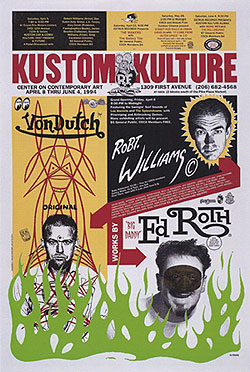
Chantry has achieved prominence and spawned dozens of imitators
by producing riffs on history – in graphics that show a special
affection for obscure or outmoded forms. These designs speak on
several levels. They contain inside references to Seattle’s
culture, where for twenty years they have helped to galvanize and
document the city’s music, theater, and art scenes. (“Chantry
isn’t just a figure in the development of what is known as
the Seattle style, he’s the reason there is such a thing,” the
Seattle art critic Regina Hackett wrote in 1993.) And they pay
homage to old, neglected masters of popular culture in a style
that would be too hastily labeled retro. Challenged by the low
budgets typical of his clients – garage-band record labels,
local clubs, nonprofit social groups, small theater companies – he
has explored and exploited low technology’s creative potential.
Because his goal is to self-consciously perpetutate forms from
the past, he is an archaeologist as well as an artist, preserving
as well as reinventing artifacts of design, especially ephemera
that others would not consider worth keeping: comic books, pornography,
carnival graphics, ads found in the backs of old trade magazines,
pictures of hucksters and long-forgotten politicos.
“He uses the word subculture to refer to tribal creative groups that share a language,
a set of heroes, and a body of historical knowledge...Skateboarders are an example, so are drag queens and drag
racers”
Chantry’s main source of collage materials is subcultures.
He uses the word subculture to refer to tribal creative groups
that share a language, a set of heroes, and a body of historical
knowledge considered arcane to outsiders. Skateboarders are an
example. So are drag queens and drag racers. Once upon a time letterpress
printers and typographers formed subcultures too, he says, before
digital technology wiped out most of their businesses. These fraternal
orders (they are in fact composed primarily of men) tend, moreover,
to be blue collar with little hope of upward mobility, and their
members practice tricks of economy that sometimes indirectly produce
novel aesthetic effects. Whether their instrument is a car engine,
a guitar, or a letterpress, members of subcultures know its mechanics;
to take apart and rebuild – to customize – is a form
of expression as well as the low-budget key to greater speed and
precision.
Although Chantry has made no formal study of subcultures, his characterizations
resemble those offered by cultural studies experts. In her introduction
to The Subcultures Reader, coeditor Sarah Thornton distinguishes
subcultural groups in general terms: they are perceived as “oppositional.” They
are “envisaged as disenfranchised, disaffected and unofficial.
Their shadowy, subterranean activities contrast dramatically with
the ‘enlightened’ civil decencies of the ‘public.’” They
are “generally seen as informal and organic.” They
are defined by what they are not: “The emphasis is on variance
from a larger collectivity who are invariably, but not unproblematically,
positioned as normal, average, and dominant. Subcultures, in other
words, are condemned to and/or enjoy a consciousness of ‘otherness’ or
difference.”
Chantry’s observation that the members of subcultures demonstrate
a mastery over materials and tools echoes writings by the scholars
John Clarke and Dick Hebdige, who perceive a link between subcultures
and bricolage, or the practice of building with whatever materials
come to hand. (The terms derives from the French word bricoler, “to
putter about,” and won its theoretical status in the writings
of the French anthropologist Claude Lévi-Strauss, who used
it to describe the way in which “primitive man” made
sense of the physical world.”)4 One can see why Chantry dwells
on this aspect of subcultures. Constructing from mongrel parts
or improvising with found objects is effectively a style of collage,
but not collage as it is mostly practiced in the computer age.
Computers allow designers to manipulate information in countless
ways, yet the final results are rarely translated exactly as they
are viewed on the monitor. Computers are instruments of hypothetical
desire, whereas the subcultures that Chantry admires often come
from a precomputer era of observable moving parts with an obvious
relationship to the sounds and images they generate in the physical
world. By assimilating the methods as well as the products of old
subcultures, he helps to promote them to a younger generation of
cultural outlaws – nineties garage bands, say, whose members
are infatuated with the campy pop graphics of sixties surfers.
His work is more than homage in that he inserts himself into a
tradition, which he furthermore mediates, exaggerating and redefining
the antiquated styles and images he resurrects.
“Chantry doesn’t work on a computer. His
tools are the printing press and the photocopier (a kind of press,
after all, in its power to manufacture multiple images), and he knows how to use them.”
I learned about printing technology by doing it: just going
to press checks, talking to those guys, watching or thinking. It’s
pretty logical. The press puts down one layer of color at a time.
That’s all you basically need to know. The rest of it is
how you manipulate the way the ink hits the paper, and everything
I do is aimed at that process. Nothing really exists until it comes
off the press. That’s your palette and brush and pigment
right there.
His results would be nearly impossible to achieve with more sophisticated
technology, for he aims to reproduce the look of erosion and haphazardness.
For all its flexibility, the computer allows only the most skillful
graphic designers to represent accidents digitally as unpremeditated
gestures. Just as the writer who works on-screen never reveals
the inked-out lines that indicate the tussle of finding the mot
juste, so the designer confined to digital tools can’t help
covering up a succession of revisions. But printing is full of
accidents that one cannot erase, and the degradation achieved by
alternately reducing and blowing up type on a photocopier (a standard
Chantry technique) produces an otherwise hard-won texture of decay.
Chantry, like the Dada artists, prizes the paradox of carefully
controlled spontaneity to match the exuberance of the original
designs he puts in his collages, and he captures ephemeral states
in part to blend old and new material. Spontaneous messes are desirable
if they can be harnessed into precise form. Here, for instance,
is how he created a promotional poster for the Philadelphia-based
clothing chain Urban Outfitters: “We took all the paper and
we threw it on the ground in the silk-screen shop. Then we took
it out and threw it onto the street and let cars run over it. Then
we silk-screened onto it”).
Chantry developed a mastery of his tools also for budgetary reasons.
Because he couldn’t afford professional typesetting early
in his career, he learned typography by cutting out printed letterforms
and pasting them down one by one with a glue stick. He continues
to be famous among his peers for his vast collection of old press
type – the stick-down letters amateurs once relied on for
professional-looking text. Chantry still uses the stuff, especially
when it’s dried up and chunks of the letters have broken
off. He refined his color sense by creating his own separations,
preparing the color plates to be combined on press, a step normally
left to experts. He knows design to its bones. Though he rarely
illustrates from scratch, he is a skillful draftsman, and his cleverly
elaborate music packaging reveals that he is as comfortable working
in three dimensions as in two.
“I have this theory about the continental U.S., Chantry explains, the
corners are where people who don’t fit in go to find new
life, and they keep piling up in the corners because there’s
no place farther they can go.”
Marginality is a large theme for him. Subcultures are defined by
words like alternative and underground, evoking both sideways tributaries
from an American mainstream and immersion into unsettling, even
dangerous, below-grade activities. One of his clients, a compiler
and producer of small local bands, even assume the name Subterranean
Pop, later Sub Pop, to signal its interest in alternative music.
His hometown breeds extremism, Chantry believes, the most recent
evidence being the protests that disrupted the 1999 World Trade
Organization talks in Seattle and the city’s decision to
cancel its 2000 New Year’s festivities out of the fear or
terrorism. As in other lovely, low-density western regions, this
one has attracted utopians from both ends of the political spectrum,
activists and isolationists, communitarians and libertarians. “I
have this theory about the continental U.S.,” Chantry explains. “The
corners are where people who don’t fit in go to find new
life, and they keep piling up in the corners because there’s
no place farther they can go.”
Nonetheless, Chantry believes that Seattle’s underground
culture has been in decline over the past twenty-five years, and
he blames the erosion partly on another migration pattern: the
exodus of creative spirits in search of better opportunities. “A
lot of famous people in the punk and psychedelic scenes came from
the Northwest. They couldn’t make a living so they migrated
south. For talent, south is the only place to go unless you go
east to Chicago or New York.” In fact, many of his circle
of culturally minded designers, including a large number who worked
with him on the monthly music magazine The Rocket, the site of
some of his most innovative work, abandoned Seattle for bigger
cities. He views himself as a holdout in an alien environment.
“after years of trying, (conservatives) finally curtailed the display
of street posters in 1994, on the unconvincing pretext that they were dangerous
to workers climbing utility poles”
Chantry blames another part of the counterculture’s demise
on Seattle’s transformation into a high-tech capital attracting
straightlaced entrepreneurs. When, in 1999, software company Adobe’s
regional headquarters moved into a large complex in the liberal
neighborhood of Fremont, the new building signaled yet one more
triumph of the corporate drone (however youthful) over the free-spirited
artist (however grizzled). Of Fremont’s landmark statue of
Lenin, Chantry quotes the designer Frank Zepponi as suggesting
that someone should “put a cash machine in its butt” to
comment on its transmutation of neighborhood values. Not that Seattle,
the home of defense giant Boeing, ever lacked for traditionalists.
But Chantry judged it an ominous blow to the underground when local
conservatives, after years of trying, finally curtailed the display
of street posters in 1994, on the unconvincing pretext that they
were dangerous to workers climbing utility poles, and thereby cut
off an important advertising medium for small theaters and clubs.
Much can be learned about the self-image of Seattle’s cultural
purists from the titles of a documentary film and book devoted
to the city’s music scene. The 1996 movie Hype, directed
by Doug Pary, is about the grunge phenomenon of the late eighties
and early nineties, when a few bands found their way to the national
stage and attention was suddenly turned not just to every scruffy
teenager in the region who strummed an electric guitar but also
to the teenager’s attire and speech habits. Eventually flannel
shirts and work boots appeared on the pages of Vanity Fair, modeled
by the likes of Joan Rivers. Meanwhile, the New York Times published
a lexicon of grunge terms that had been handily invented on the
spot by a sales rep at Sub Pop.
Complementing the dismissively titled Hype, the 1995 book Loser,
by Clark Humphrey, chronicles Seattle’s music scene back
to the fifties, when Northwest bands like the Sonics and the Wailers
fueled early rock and roll, and culminates in the decline of grunge.
Like Hype, Loser is a story of original talents that were misappropriated,
canned, puffed up, adulterated with weaker substances, and finally
killed off. If Kurt Cobain hadn’t existed to inflict a fatal
gunshot on himself after reaching international celebrity, both
Hype and Loser would have had to invent him, for the ultimate lesson
of each history is that authentic talent cannot bloom far beyond
its native soil; transplanted, it mutates into a weed or is choked
to death.
“The loser is the existential hero of the 90’s”
Given his prominent role in Seattle’s underground, it is
no coincidence that Art Chantry is featured early and repeatedly
in Hype, where we first see him shredding punk posters with a paper
cutter and joyfully recounting episodes of Northwest luridness,
the “dark side” captured most famously by David Lynch
in his 1980s television series Twin Peaks. And Chantry not only
designed Loser’s cover and pages, but also suggested the
book’s title (he borrowed it from Kurt Danielson of the Seattle
band TAD, who proclaimed, “The loser is the existential hero
of the 90’s”). Still, it would be too much to credit
the self-deprecation of both Hype and Loser to Chantry’s
influence, just as it would be inaccurate to suggest that Chantry
is merely a representative of a city suffering from an inferiority
complex: In some ways, he embodies a frontier town that is aware,
with a mixture of pride, humility, and disdain, of its place on
the edge, but ultimately, like anyone else, he is his own unique
product. Genes, pranks, barflies, heroes, gray skies, conifers,
countless sitcoms, yellowing newsprint, and the stain of printer’s
ink are all melded into the collage of Art Chantry. This book represents
an effort to disassemble some of its intricate components and to
show how they are reconfigured in the work.
|